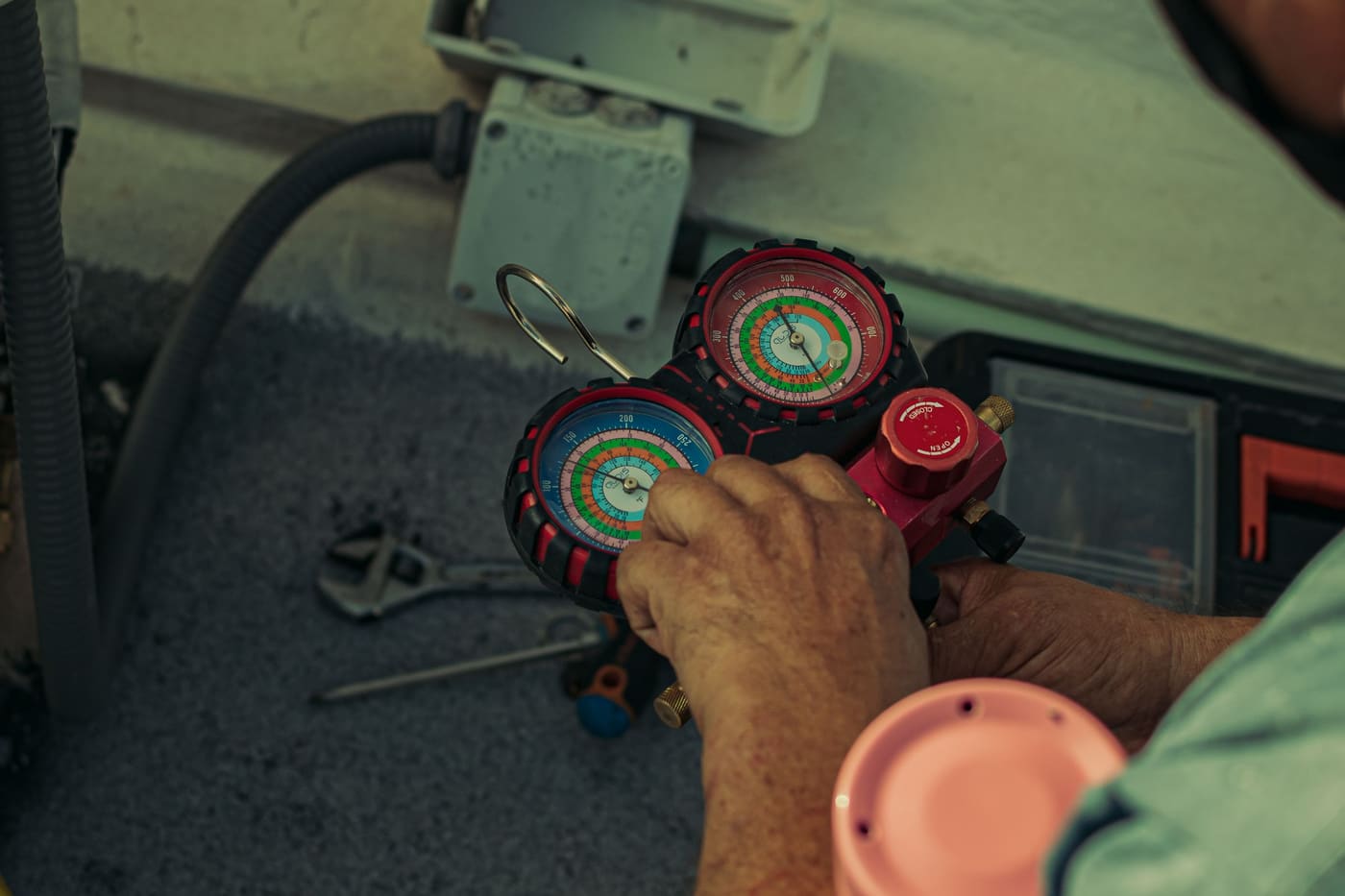
What Is on the EPA 608 HVAC Certification Test, and How Do You Pass It?
The EPA 608 HVAC certification test has a 25-question Core section plus 25 questions for each type you take: Type I, Type II or Type III. Universal is all four sections, 100 questions. You pass a section with 70%, which means 18 correct answers out of 25. The practice test below covers every section, with each answer tied to the federal rule it comes from. For the types and where to test, see the EPA 608 certification guide.
The pages that rank for an EPA 608 practice test mostly hand you a quiz bank with no reasons behind the answers. That works until the real exam words a question differently. Every answer below names the federal rule behind it, so you learn why it’s right. Read the question, pick an answer, then open it to check.
How the EPA 608 Test Is Scored
Each section has 25 multiple-choice questions, and you pass a section with a score of 70%, which means 18 correct answers. EPA writes the question bank, and approved certifying organizations build each test from it (40 CFR Part 82, Appendix D).
| Certification | Sections you take | Questions | Passing score |
|---|---|---|---|
| Type I (small appliances) | Core + Type I | 50 | 70% closed book, 84% mail-in |
| Type II (high pressure) | Core + Type II | 50 | 70%, closed book, proctored |
| Type III (low pressure) | Core + Type III | 50 | 70%, closed book, proctored |
| Universal | Core + Types I, II and III | 100 | 70% on each section |
Everyone takes Core. You don’t have to earn Universal in one sitting: passing scores on separate Type I, II and III tests combine into Universal. The EPA 608 certification guide explains which equipment each type covers.
Core Practice Questions
Core covers the ozone layer, the Clean Air Act, the venting ban, recovery, recycling and reclaiming, and safety. EPA’s test topics list shows each one.
How full can you fill a refrigerant recovery cylinder? A) 70% B) 80% C) 90% D) Full to the valve
Answer
B) 80%. EPA’s Core safety topics say never to fill a cylinder beyond 80% full. The empty space leaves room for liquid refrigerant to expand as it warms.
Which gas should you use to pressurize a system for a leak test? A) Oxygen B) Compressed air C) Nitrogen D) Any of them, through a regulator
Answer
C) Nitrogen, through a pressure regulator with a relief valve. EPA’s Core safety topics rule out oxygen and compressed air for leak testing.
Who may buy refrigerant for stationary air conditioning equipment? A) Anyone B) Section 609 technicians C) Section 608 technicians, or employers of one D) Licensed contractors only
Answer
C) Under EPA’s refrigerant sales restriction, only 608-certified technicians, or employers who show proof that they employ one, can buy it. A Section 609 card covers vehicle AC only.
Type I Practice Questions
Type I covers small appliances: equipment that is fully built, charged and sealed at the factory with 5 pounds or less of refrigerant (40 CFR 82.152). Think window units, refrigerators, dehumidifiers and vending machines.
Your recovery machine was built after November 15, 1993, and the appliance’s compressor works. How much refrigerant must you recover? A) 70% B) 80% C) 84% D) 90%
Answer
D) 90%. If the compressor doesn’t work, the requirement drops to 80%. Either way, pulling the appliance down to 4 inches of mercury vacuum also meets the rule (40 CFR 82.156).
Do you need 608 certification to dispose of a refrigerator? A) Yes, Type I B) Yes, Universal C) No, but the refrigerant must still be recovered before disposal D) No, and the refrigerant can be vented
Answer
C) Federal rules don’t require certification to dispose of small appliances (40 CFR 82.161), but the recovery rule still applies when a small appliance is disposed of, and venting is banned.
What should you do with a piercing-type access valve after service? A) Leave it in place B) Remove it C) Cap it with tape D) Leave it unless it leaks
Answer
B) EPA’s Type I topics call for removing solderless access fittings when the service is finished.
Type II Practice Questions
Type II is the section most home and light-commercial technicians need, because R-410A and R-22 systems are high-pressure appliances. That means a saturation pressure between 170 and 355 psia at 104°F.
A system uses R-410A. Which certification type covers it? A) Type I B) Type II C) Type III D) Section 609
Answer
B) Type II, unless it is a factory-sealed small appliance with 5 pounds or less of refrigerant, which is Type I. The federal definitions name R-22, R-407C and R-410A as high-pressure refrigerants.
Using recovery equipment built after November 15, 1993, what vacuum must you reach before opening a high-pressure appliance with 200 pounds or more of refrigerant? A) 0 inches Hg B) 4 inches Hg C) 10 inches Hg D) 15 inches Hg
Answer
C) 10 inches of mercury. The required levels come from Table 1 in 40 CFR 82.156:
| Appliance (equipment built on or after Nov. 15, 1993) | Required vacuum |
|---|---|
| High pressure, under 200 lb | 0 inches Hg |
| High pressure, 200 lb or more | 10 inches Hg |
| Medium pressure, under 200 lb | 10 inches Hg |
| Medium pressure, 200 lb or more | 15 inches Hg |
| Low pressure | 25 mm Hg absolute |
A comfort-cooling system holding 50 pounds or more of R-22 leaks faster than the allowed rate. What is that rate? A) 10% a year B) 20% a year C) 30% a year D) There is no limit
Answer
A) 10%. Commercial refrigeration is allowed 20% and industrial process refrigeration 30%. The owner must have the leak repaired within 30 days of adding refrigerant (40 CFR 82.157). Since April 10, 2020, this federal 608 rule applies to appliances holding 50 pounds or more of an ozone-depleting refrigerant such as R-22.
Your low-side gauge reads 50 psig. What is the absolute pressure? A) 35.3 psia B) 50 psia C) 64.7 psia D) 79.4 psia
Answer
C) 64.7 psia. Add 14.7 (atmospheric pressure at sea level) to a gauge reading to get absolute pressure. EPA lists this conversion among the Type II pressure-temperature topics.
Why should you never start a hermetic compressor while the system is in a deep vacuum? A) It’s fine once the vacuum holds B) EPA’s safety rules say never energize a hermetic compressor under vacuum C) Only if the oil is warm D) Only with nitrogen in the system
Answer
B) EPA lists “don’t energize hermetic compressors under vacuum” as a Type II safety topic, so expect it as a direct question.
Type III Practice Questions
Type III covers low-pressure appliances: refrigerant below 45 psia at 104°F, as in centrifugal chillers running R-123 or R-11. Type III also covers purge units, chiller water and recharging, where you add vapor before liquid.
What level must a low-pressure appliance reach before it’s opened? A) 0 psig B) 10 inches Hg C) 15 inches Hg D) 25 mm Hg absolute
Answer
D) 25 mm Hg absolute, whatever the age of the recovery equipment. It’s the deepest level in the evacuation table.
What is the preferred way to pressurize a low-pressure chiller for a leak test? A) Oxygen B) Controlled hot water or a built-in heating device such as a Prevac C) Compressed air D) R-22 vapor
Answer
B) Hot water or a heating device comes first, and nitrogen is the second choice. EPA lists excessive purging as a sign that air is leaking into a low-pressure system.
Before you drain oil from a low-pressure system, what should you do? A) Chill the oil to 40°F B) Heat the oil to 130°F C) Add nitrogen D) Nothing, drain it cold
Answer
B) EPA’s Type III recovery topics call for heating the oil to 130°F before you remove it.
Is the EPA 608 Test Open Book?
No, except one version of Type I. Type II, Type III and Universal must be taken closed book, with a proctor, in a secure setting. Type I can also be taken on site, or as a mail-in test that requires 84% to pass. A mail-in Type I can’t count toward Universal.
Remote testing is allowed. EPA’s list of approved certifying organizations, updated October 27, 2026, marks remote testing for groups such as the ESCO Institute, Mainstream Engineering and Interplay Learning, and SkillCat and Solar One test online only. A remote test is still proctored: you show photo ID and can’t use notes. EPA approves certifying organizations, not prep courses, so check any tester against that list before you pay.
Your certifying organization must send your results within 30 days, and a wallet card within 30 days if you pass. EPA itself doesn’t issue cards.
How Hard Is the EPA 608 Test?
Much of it is recall of rules and numbers, so it’s very passable with study. The numbers to know cold are the evacuation levels, the small-appliance recovery percentages, the leak-rate limits and the November 15, 1993 equipment date. With 25 questions a section, you can miss 7 and still pass.
A study plan that works:
- Learn Core first. It’s on every test, and if you fail Core, you fail every type you take with it.
- Memorize the number tables. Write out the evacuation table and the leak rates until you can reproduce them from memory.
- Practice by section. Score each 25-question set alone, and don’t book the exam until you clear 18 correct every time.
- Test for Universal if you can. It adds the Type I and Type III sections to Core and Type II, and never limits which equipment you can work on.
If you’re in a registered apprenticeship, you can work on refrigerant circuits under close supervision of a certified technician before you pass. The HVAC apprenticeship guide explains that exemption and how long it lasts.
Schools That Build in the Exam
The easiest way to pass is in a program that teaches to the exam and gives it before you graduate. Five examples from schools’ own pages:
| School | What the program says about EPA 608 |
|---|---|
| Eastern Florida State College, Melbourne, FL | Mainstream Engineering exam, $27, taken at the college’s testing center |
| Southern Arkansas University Tech, Camden, AR | Students must pass the Universal exam with 70% or better |
| Mayfield College, Cathedral City, CA | One exam attempt per certification is included in tuition and fees |
| Midwest Technical Institute, Springfield, IL | Passing Core, Type I and Type II is required for the diploma |
| Brownson Technical School, Anaheim, CA | The required 608 exam is given during the program |
Eastern Florida State College runs its HVAC/R certificate as 1,350 clock hours over one year. For more Florida options, read which Florida HVAC schools give the EPA 608 exam, or compare programs on the Florida, California and Arkansas state pages. Once you hold 608, the HVAC certification training guide covers the next credentials employers look for, such as NATE and HVAC Excellence.
Frequently Asked Questions
Do I Need EPA 608 and 609 Certification?
Only if you work on both kinds of equipment. Section 608 covers stationary air conditioning and refrigeration. Section 609 covers motor vehicle air conditioning, and anyone who services car AC for pay needs it. The HVAC certification training guide compares the two.
Which EPA Certification Do HVAC Technicians Need?
Type II covers most home and light-commercial air conditioners and heat pumps, because they use high-pressure refrigerants such as R-410A and R-22. Universal covers every type of stationary equipment, so many employers ask for it.
Can I Take the EPA 608 Test at Home?
Yes, through a certifying organization that offers remote proctoring. EPA's list marks remote testing for groups such as the ESCO Institute, Mainstream Engineering and Interplay Learning, and SkillCat and Solar One test online only. A proctor still checks your photo ID and watches the test.
Does EPA 608 Certification Expire?
No. Federal rules have no renewal requirement today, though EPA keeps the right to add one. Keep a copy of your certificate at your place of business until three years after you stop working as a technician.
Can I Take the EPA 608 Test in Spanish or Orally?
Often, yes. EPA encourages certifying programs to offer the test in other languages or allow a translator. You can ask for an oral test by sending the program a written request at least 30 days before the exam that explains why.
Guides on This Topic
More HVAC Guides
All posts
Florida · Certification Testing
Which Florida HVAC Schools Give the EPA 608 Exam?
Florida HVAC schools that give or prepare you for the EPA 608 exam, from Lively Technical College's testing site to Futura's on-site Universal exam.
National · Certificates and Degrees
HVAC Certificate or Associate Degree: Which Should You Choose?
An HVAC certificate takes one to three semesters; an associate degree takes about two years. Compare credit hours, tuition and fit at real colleges.
National · Cost
What HVAC Students Spend on Books, Tools and Supplies
HVAC books and supplies run from $500 a year at St. Philip's College to $3,864 at Sampson Community College. See what schools list and what's included.
Sources
- eCFR: 40 CFR Part 82, Subpart F, Appendix D (test standards)
- eCFR: 40 CFR 82.161, technician certification
- eCFR: 40 CFR 82.156, required evacuation levels
- eCFR: 40 CFR 82.157, leak repair
- eCFR: 40 CFR 82.152, definitions
- EPA: Section 608 technician certification test topics
- EPA: Certification programs for Section 608 technicians (updated October 27, 2026)
- EPA: Refrigerant sales restriction